

THERAPY FOR HEALTHCARE WORKERS
THERAPY FOR
HEALTHCARE WORKERS
How Long Can You Carry What
No One Else Sees?
You're used to being the calm one — the one who doesn't flinch when everyone else does. But that calm isn't free. It costs something every time you swallow it instead of feeling it.
In this space, you don't have to explain what a bad shift actually does to a person. You don't have to translate what you've seen into something someone outside healthcare could stomach. You can just show up — still in your scrubs if you need to be — and finally put some of it down.
You’ve spent years taking care of others. You deserve someone who can show up for you in the same way.
Does this sound familiar?



You spend your whole day caring for other people, but struggle to care for yourself
You hold yourself to high standards and struggle to feel like what you do is enough
You know how to perform and get things done but you’re not sure how to rest.
You’ve become so focused on surviving work that you barely recognize yourself outside of it.
You know how to hold it together.
But you don’t know how to put it down.
You deliver devastating, life-changing news, then walk into the next room and smile at a scared kid getting stitches like nothing happened.
You've gotten so good at compartmentalizing that it almost scares you — how easily you can switch it off mid-shift — until you're driving home and it all catches up with you at once, alone, in the quiet.
Healthcare doesn't just ask you to work hard. It asks you to witness people on the worst day of their life, then keep functioning like it never happened. Most people who haven't done this work have no idea what that actually costs.
You show up anyway. Every time. But nobody ever taught you how to actually put it down once the shift ends.
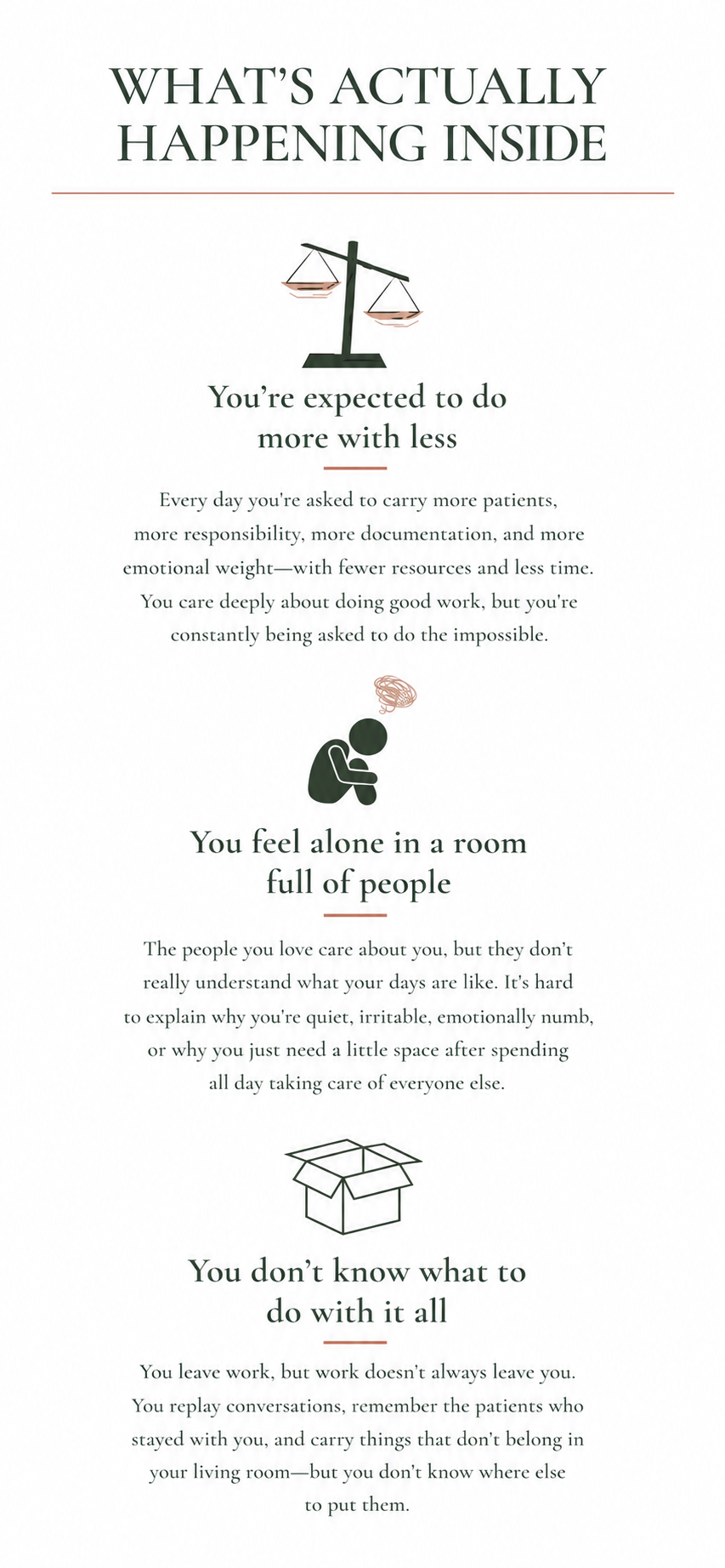
You’re expected to do more with less
Every day you're asked to carry more patients, more responsibility, more documentation, and more emotional weight—with fewer resources and less time. You care deeply about doing good work, but you're constantly being asked to do the impossible.
WHAT’S ACTUALLY
HAPPENING INSIDE
You feel alone in a room full of people
The people you love care about you, but they don't really understand what your days are like. It's hard to explain why you're quiet, irritable, emotionally numb, or why you just need a little space after spending all day taking care of everyone else.
You don’t know what to do with it all
You leave work, but work doesn't always leave you. You replay conversations, remember the patients who stayed with you, and carry things that don't belong in your living room—but you don't know where else to put them.
You’re not allowed to fall apart
You're the person other people fall apart with — the patient’s and family getting life altering news, the coworker having a rough day. So you learn to hold it together no matter what's happening, and it's hard to remember how to let that guard down.
IN THEIR OWN WORDS

“I hold people's hands while they die and then go home and make dinner like nothing happened. I didn’t realize what that was actually doing to me.”
"Nobody warns you that you'll start feeling numb to the things that used to break your heart… and that the numbness scares you more than the grief ever did.”
"I used to think needing therapy meant I wasn't cut out to be a nurse anymore. Turns out it's the only reason I'm still good at it."
-CURRENT CLIENT
" I don't think I realized how much I was bringing home. I spent years convincing myself I was 'fine' and that being grumpy and exhausted was just part of the job. Christine understood the parts of healthcare I couldn't explain to other therapists. For the first time in a long time, I felt seen.”
— Former Client

The goal isn’t to care less. It’s about helping you take care of yourself the same way you do for everyone else.
HOW THERAPY CAN HELP
It’s about building enough flexibility that the job doesn't cost you everything outside of it.
This isn't about doing less or becoming numb to it.
You're used to running on adrenaline, then flipping a switch to function normally the second the crisis is over. There's rarely room to actually feel something in the moment — so you learn to file it away and deal with it later.
Except later rarely comes, and eventually that distance catches up with you: from your own emotions, your body, and the parts of your life that have nothing to do with work.
In our work, l will help you do 4 important things
MAKE SENSE OF WHAT YOU’VE BEEN FILING AWAY
We'll go back to the moments you didn't have time to actually feel in real time, and finally give them the space they never got.
01
RECONNECT WITH YOURSELF, NOT JUST YOUR ROLE
After long enough running on autopilot, it's easy to lose touch with what you actually feel underneath the competence. We'll work on finding that again.
02
CATCH YOURSELF BEFORE SWITCHING TO AUTOPILOT
We'll build the pause between what happens and how you react, so you're not just defaulting to push-through every time.
03
LEARN TO SET IT DOWN WITHOUT SHUTTING DOWN
We'll find real ways to leave work at work — ones that don't require going numb to do it.
04
Someone Who
Understands
the weight
of Healthcare

Healthcare has its own culture, and it's hard to explain to anyone who hasn't lived inside it. I spent over a decade as a hospital, ED, and hospice social worker — and I still work as an ED social worker today, alongside my private practice.
So you won't have to translate the pace, the pressure, or why certain moments stick with you. I understand the weight of the decisions you carry, and how easily your own strain gets pushed aside so you can take care of everyone else.
This isn't hypothetical for me. I go back into it every shift — I’ve just learned what it costs if you never put it down.
Want to learn more about my background and approach? → READ MY FULL BIO

IF MY APPROACH FEELS LIKE
the kind of support
you’ve been looking for
I would love to meet you.
NO PRESSURE. JUST A CONVERSATION