

THERAPY FOR
FAMILY CAREGIVERS
THERAPY FOR FAMILY CAREGIVERS
What Happens
When Love Starts
To Feel like Responsibility?
When someone you love needs more of you, it's easy to slowly disappear from your own life.
It happens one appointment, one medication, one crisis, and one sacrifice at a time—until somewhere along the way, you realize there's very little of you left.
You’ve spent so much time focusing on what others need. You deserve a space to reconnect with what you need too.
Does this sound familiar?




You spend so much time taking care of everyone else that caring for yourself feels unfamiliar—or even selfish.
You're trying to keep your own life afloat while quietly carrying someone else's too.
You're grieving the changes in someone you love—even though they're still here.
Everyone needs something from you, and there never seems to be enough of you to go around.
You love them deeply.
But that doesn’t make it any easier.
What once felt like a relationship now feels like constant coordination, endless decisions, and carrying responsibilities that never really end.
The emotional weight of caregiving isn't always obvious from the outside. Most family caregivers keep showing up, doing what needs to be done, while quietly wondering how much longer they can keep doing it this way.
It's possible to feel love, grief, resentment, responsibility, and exhaustion—all at the same time.
And there are very few places where you get to say those things out loud.
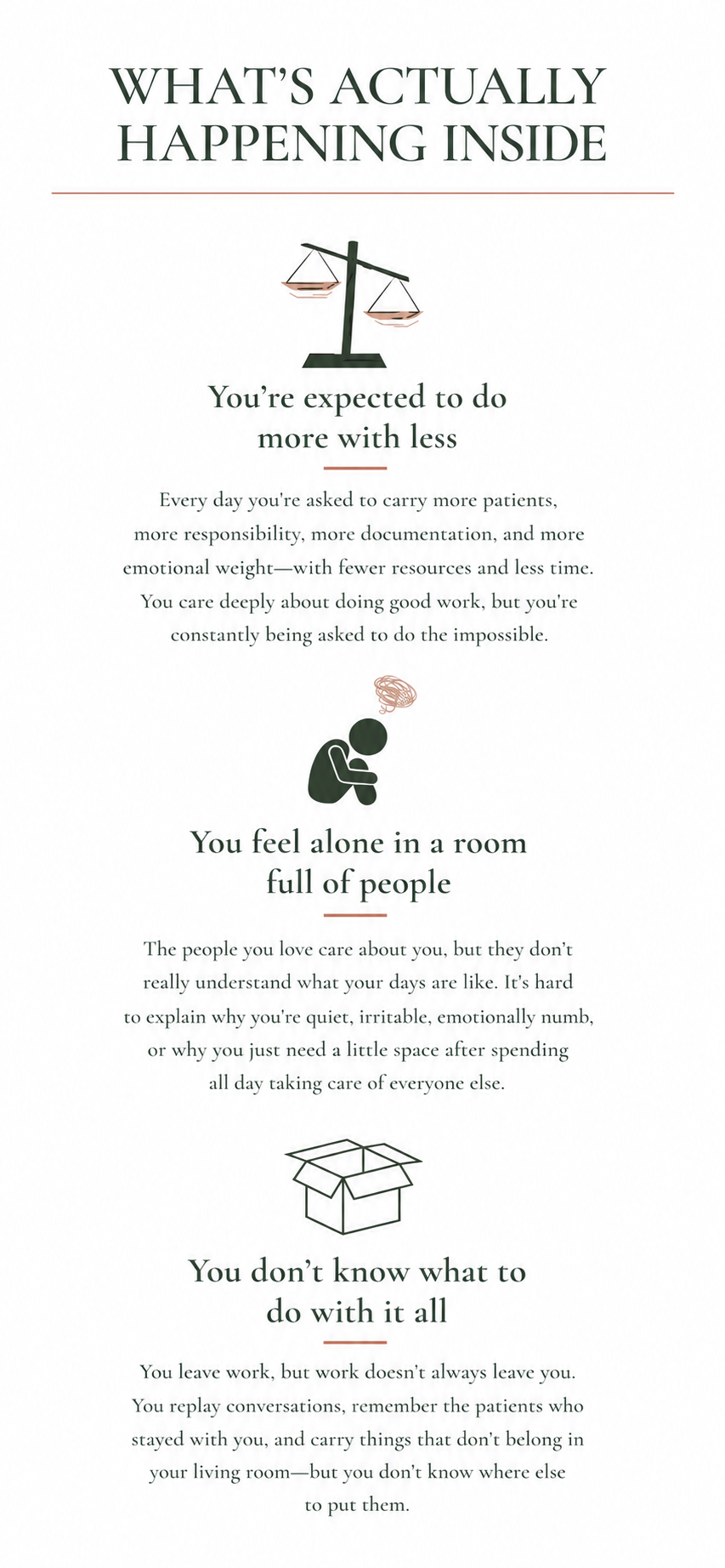
WHAT’S ACTUALLY
HAPPENING INSIDE
You feel guilty no matter what you choose
When you're caring for them, you wonder what you're neglecting elsewhere. When you take a break, you wonder if you should have stayed. No matter what you choose, it somehow feels like you're letting someone down. Even rest starts to feel like something you have to justify rather than something you're allowed to just need.
You can’t turn your brain off, even if you try
Even when you're finally sitting down, you're mentally running through medications, appointments, phone calls, and everything that still needs your attention. Your body is home, but your mind never really stops caregiving. You'll catch yourself mid-conversation with someone else thinking about what you need to do next.
You miss the person they used to be
They're still here... but so much has changed. You're grieving what you've lost while trying to stay present for what remains. Some days that grief sneaks up on you in small moments — a phrase they used to say, a way they used to laugh — and it catches you off guard even though you know it's coming.
You feel things you think you shouldn’t feel
Resentment. Exhaustion that turns into irritability. A flash of wanting your old life back before the guilt crashes in.
Nobody talks about this side of caregiving — the love is real, but so are the feelings you're not "supposed" to have alongside it, and carrying both in silence is its own kind of exhausting.
IN THEIR OWN WORDS

"There's no manual for watching your husband disappear a little more each day. I came in barely holding it together and she didn't try to fix it. She just let me say the awful thoughts out loud… the ones about wishing it would just be over already… without making me feel like a monster for thinking them."
"My mom doesn't remember my name most days now. I needed someone to tell me that grieving her while she's still alive isn't crazy."
"Everyone kept telling me I was 'so strong,’ like I had any other choice.
I didn't feel strong. I felt like I was quietly drowning. Christine was the first person who noticed I wasn’t OK."
-FORMER CLIENT
-CURRENT CLIENT

The goal isn’t to love them less. It’s to stop losing yourself in the process.
HOW THERAPY CAN HELP
This isn't about getting you to do less or stop caring.
It's about helping you find a way to carry it differently so it doesn't completely deplete you.
You didn't sign up to lose yourself in this. But somewhere between the medication schedules, the appointments, the phone calls with doctors, and the decisions no one else can make for you, your own needs quietly moved to the bottom of the list — and stayed there.
Even when you notice it, stepping back can feel like betrayal — like taking care of yourself means caring less about them. It doesn't. But it's hard to believe that when guilt has been running the show for this long.
So, here’s where we start….
UNDERSTAND THE INVISIBLE LOAD
We’ll identify the emotional and mental weight you’ve been carrying — the guilt, the pressure, hypervigilance, and constant responsibility that often go unnoticed by others
01
RESPOND WITHOUT RUNNING ON EMPTY
We’ll build awareness around burnout, overwhelm and survival mode and find new ways to care for yourself while still showing up for the people you love
03
MAKE SPACE FOR YOURSELF AGAIN
We’ll work on reconnecting with your own needs, emotions and identify outside of being the caregiver and person everyone else depends on.
02

CREATE A MORE SUSTAINABLE WAY FORWARD
Together, we’ll help you set boundaries that are maintainable within your current situation, navigate difficult emotions and decisions and create a life that feels more balanced, grounded and manageable.
04
Someone Who
Understands
the Weight
of Caregiving
HI, I’M CHRISTINE

I’ve spent more than a decade working in hospitals, ERs and hospice, sitting with families during some of their most difficult times. I’ve seen the emotional weight caregivers carry: the advocacy, the decisions, the fear, the grief and the pressure to keep going even when they’re exhausted.
I also understand caregiving from the inside. I know how quickly your own needs can move to the bottom of the list when someone you love needs you.
I’ve lived that chapter of life where you love someone completely and still feel like you're disappearing.
Want to learn more about my background and approach?
the kind of support
you’ve been looking for
IF MY APPROACH FEELS LIKE
I would love to meet you.
NO PRESSURE. JUST A CONVERSATION